· Nas · Technology · 10 min read
How to Validate and Launch a Business Idea with Claude AI
90% of startups fail because they build something nobody wants. Here's the Validation Sprint - a free framework to go from random idea to first lead captured in a single afternoon, using Claude.
How to Validate and Launch a Business Idea with Claude AI
90% of startups fail, and it’s usually for one reason: they build something nobody actually wants. Even if you spend 6 months and thousands of dollars building the coolest product ever, you’ll launch and hear nothing but crickets.
That won’t happen if you follow the process I’m laying out in this post.
I’m going to teach you how to compress the entire validation cycle - from “random idea” to “first lead captured” - into a single afternoon. I call it the Validation Sprint. A free, repeatable framework to identify a winning business idea before you write a single line of code or spend a single dollar on ads.
You’ll use different tools, with Claude as the intelligence layer overseeing the whole process. The first three steps are simple to execute. Step 4 is where it gets more challenging, but if you push through it, your odds of building a successful business will drastically improve.
Let’s get into it.
Validated? Now launch
Build your beautiful website today
The idea checks out. Time to put it online. My complete step-by-step pack takes you from a blank screen to a real website, live on your own domain - plus a private 1-on-1 call with me.
Build My Website With Claude →Lifetime access · Beginner friendly · No code needed
Prefer it done for you? Get in touch →
What Is the Validation Sprint?
The Validation Sprint is a 5-step process:
- Define and stress-test your business idea with Claude
- Refine your Ideal Customer Profile (ICP)
- Find where your ICP actually hangs out online
- Build a landing page and capture real interest with LeadLanding
- Share it, measure conversion, and decide whether to build
The entire loop can be done in a single afternoon. And if it doesn’t work the first time, you can run it again from Step 1 in under 30 minutes.
Follow Along with a Video Tutorial
If you’d rather watch and follow along, I walk through the full Validation Sprint step by step in this video:
Step 1: Define and Stress-Test Your Idea
Every business starts with a hypothesis. Something like: “I think this problem exists, and here’s how I’d solve it.” That’s your starting point.
Write it down in plain language, so no more than one or two sentences. For example:
An AI SDR Agent that researches prospects before every sales call and gives you talking points that help close the deal.
Once you have your idea, take it to Claude and run it through this prompt. The goal isn’t to get a magic formula. It’s to go back and forth with Claude to challenge, refine, and sharpen your idea before you invest any time or money into it. Use Plan Mode if you’re in Claude Code, or just paste the prompt in Claude Chat.
You are a brutally honest startup advisor focused on validation, not hype.

Your job is to evaluate and stress-test a business idea before it is built.

I will give you a business idea. You must:

1. CLARIFY THE IDEA
- Restate the idea in one clear sentence
- Ask me questions that help us refine the idea
- Define the core problem it solves

2. CHALLENGE THE IDEA
- List the top 5 reasons this idea might fail
- Identify existing alternatives (tools, behaviors, competitors)
- Explain why customers might NOT switch

3. POSITIONING
- Give 3 different positioning angles
- Provide a strong one-line value proposition for each

Important rules:
- Be skeptical and critical
- Avoid generic advice
- Be specific and practical
- Prioritize clarity over optimism

Now here is the idea:

[PASTE IDEA HERE]
Work through Claude’s responses. Refine the idea until you have something sharp and specific — a real problem, a clear solution, and a reason someone would pay for it.
Step 2: Refine Your Ideal Customer Profile
You have a refined idea. Now you need to get crystal clear on who you want to sell it to, because the faster you find people who would actually pay, the faster you can validate.
For this step, use the ICP Lead Research Assistant skill from the Claude Skills community. You can find it here: ICP Lead Research Assistant on GitHub.
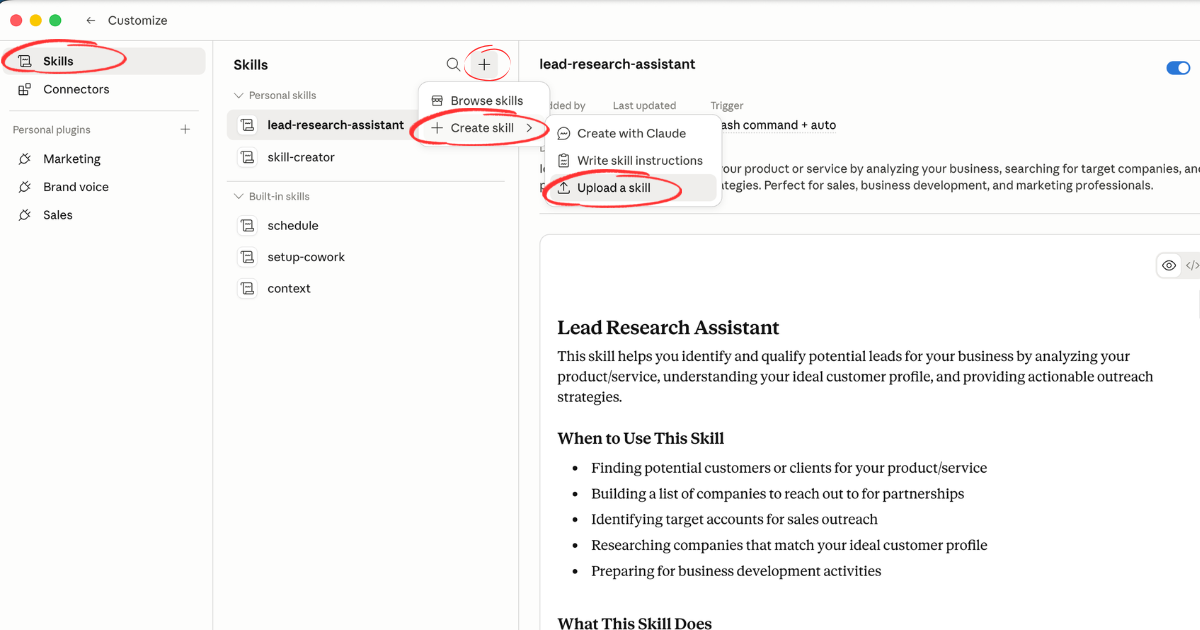
To add a skill in Claude Cowork:
- Download the
SKILL.mdfile from the link above - Open Claude desktop and go to Customize → Skills
- Click the + button → Create skill → Upload skill
- Upload the file you just downloaded
The skill will help you build a structured ICP: their role, company size, industry, goals, frustrations, and what makes them ready to buy. By the end of this step, you should be able to describe your ideal customer in a single paragraph.
Step 3: Find Where Your ICP Is
You have your idea and your ICP. The next question is: where do you find these people?
This is where most founders waste weeks guessing. Instead, use this prompt to map it out in minutes:
You are a go-to-market strategist focused on finding where a specific ICP actually spends time and can be reached.

I will give you a clearly defined ICP. Your job is to map where they exist online and how to reach them efficiently.

You must:

1. ICP RECAP
- Restate the ICP clearly (role, company size, industry, geography if relevant)

2. WHERE THEY HANG OUT (HIGH SIGNAL)
List the most relevant places this ICP is active. Be specific:
- LinkedIn (types of posts, who they follow, how they engage)
- Communities (Slack groups, Discords, forums)
- Newsletters / creators they follow
- Events / webinars they attend
- Job boards or hiring platforms (signals of activity)

3. ACQUISITION CHANNELS (PRIORITIZED)
Give the top 5 channels to reach this ICP ranked by:
- Speed (how fast you can get in front of them)
- Cost (cheap vs expensive)
- Signal quality (how targeted it is)

4. EXACT TACTICS
For each top channel, provide:
- A concrete tactic (not generic)
- Example outreach angle or hook
- Why this works specifically for this ICP

5. LOW-COMPETITION OPPORTUNITIES
- List 2–3 underutilized or non-obvious places competitors are likely ignoring

6. WHAT NOT TO DO
- List 3 channels that seem logical but are actually ineffective for this ICP
- Explain why

Important rules:
- Be specific, not generic
- Avoid obvious answers unless you add nuance
- Focus on actionable tactics, not theory
- Prioritize scrappy, fast validation methods over long-term brand strategies

Now here is the ICP:
[PASTE ICP HERE]
By the end of this step, you’ll know exactly where your ICP lives, which channels are worth your time, and which ones to skip entirely.
Step 4: Build a Landing Page and Capture Real Interest
This is the most important step in the entire process, and where the real validation happens.
You need to get your idea in front of real people and see if they actually care. The fastest, cheapest way to do that is with a landing page that captures leads.
Use LeadLanding to build it. LeadLanding is a free tool that lets you spin up a landing page in minutes. It comes with a built-in lead capture form, so you can see exactly how many people are interested enough to leave their email, which is the closest signal you’ll get to “I would pay for this” before you’ve actually built anything.
LeadLanding also has built-in analytics, so you can see how many people visited your page, where they came from, and how they behaved. That data is gold as you start thinking about your launch strategy.
You can read more about how to use it on our LeadLanding tools page.
Your landing page should communicate three things clearly:
- What problem you’re solving
- How your solution solves it
- Why someone should care right now
Keep it simple. One strong headline, two or three benefit bullets, and a form to capture their email. That’s it.
Step 5: Share It and Measure Conversion
Now push it out. You have a landing page, get it in front of your ICP using what you found in Step 3.
Try Facebook groups, Reddit threads, X (Twitter), Threads, Instagram, LinkedIn, TikTok, and even YouTube. Post where your ICP actually spends time, not where you feel comfortable.
Here’s how to read the numbers once you start seeing traffic:
| Conversion Rate | What It Means |
|---|---|
| Under 10% | Weak - revisit your positioning or targeting |
| 10–20% | Good - there’s real interest here |
| Over 20% | Strong - push harder and start building |
These benchmarks vary by industry, so always compare against what’s typical in your space. Claude can help you find comparable benchmarks if you’re unsure.
If you want to move faster, run a simple paid campaign. For around $25, you can get in front of 1,000 people in 2 days - enough to get a signal without burning budget. If you go the paid route, watch your click-through rate (CTR):
| CTR per 100 impressions | What It Means |
|---|---|
| Under 3 clicks | Weak hook or wrong audience |
| 3–10 clicks | Good - the message is resonating |
| Over 10 clicks | Strong - scale it |
A low number doesn’t automatically mean the idea is bad. It can simply mean you’re targeting the wrong audience or your hook needs tweaking. Adjust and push again.
If you push your landing page to 200 people in your target audience and nothing happens, go back to Step 1. The whole cycle takes about 30 minutes to go through, so the framework isn’t the bottleneck - your willingness to iterate is.
Once You Have Interest: Build It
Once you’re seeing real conversion numbers with people signing up, responding, reaching out - it’s time to build.
For this, I recommend Claude Code. If you’ve never used it, start with the beginners guide to get set up, then follow the full tutorial to build your first product. And when you’re ready to go live, check out the guide on how to deploy your website for free with Vercel - it’s a step-by-step walkthrough from export to custom domain.
If you get stuck at any point in the process of validating, building, or launching - reach out via the contact page. I’m happy to help.
Summary: The Validation Sprint
Here’s the full framework at a glance:
| Step | What to Do | Tool |
|---|---|---|
| 1. Define idea | Stress-test your hypothesis | Claude (Advisor prompt) |
| 2. Define ICP | Build a sharp customer profile | ICP Skill (Claude Cowork) |
| 3. Find ICP | Map where they are and how to reach them | Claude (GTM prompt) |
| 4. Land the page | Build a free landing page + lead capture | LeadLanding |
| 5. Push and measure | Share, track conversion, and decide | Social + paid ads |
The framework is free. The tools are free. The only thing standing between your idea and real validation is the hour it takes to run through this once.
If it doesn’t work the first time, run it again. The iteration is the work.
Liked what you just saw? Follow me on Youtube or connect on LinkedIn for more insights on growing your business online.
Video Guides you might like:
 How to use Claude Code to build Apps
  10 Best Claude Code Skills for beginners
  How to create AI Video Animations with Claude + Remotion
  How to use Claude Code to build a Website
  How to use Claude Skills for beginners
  How to write the PERFECT CLAUDE.md file
  Automate 80% of your Marketing with Claude
  How to use Claude Code — The basics
  Work 2X Faster with Claude Cowork
  How to NEVER Hit Claude Usage Limits Again