· Nas · Technology · 15 min read
How to Launch a Product on Product Hunt (Beginner Guide)
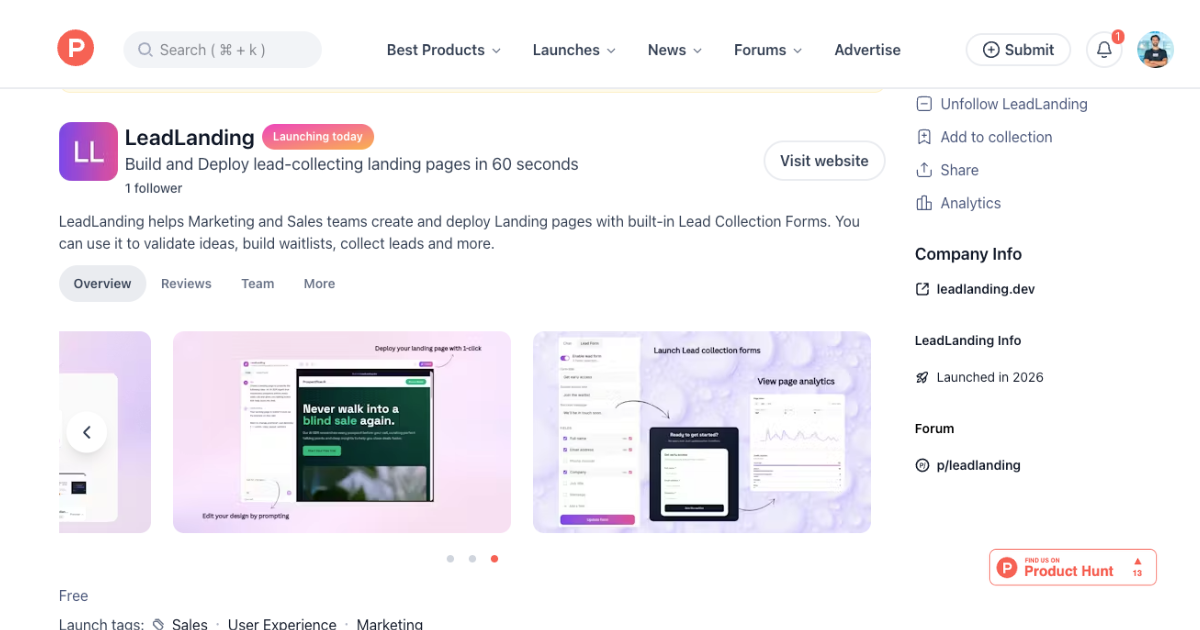
Launching on Product Hunt can put your product in front of thousands of early adopters — but only if you know how the platform actually works. Here's what I learned from launching LeadLanding on PH, including what to do, what to avoid, and what to realistically expect.
How to Launch a Product on Product Hunt (Beginner Guide)
Product Hunt is one of the most well-known platforms for getting your product in front of early adopters, makers, and the broader tech community. On a good day, a successful launch can bring thousands of visitors, early signups, and real credibility for your product.
I launched LeadLanding - my landing page builder for lead collection — on Product Hunt, and I learned a lot from going through the process. Some things worked exactly as expected. Others were surprising. This guide covers everything I wish I knew before the day arrived.
If you haven’t validated your product idea yet, I’d recommend reading How to Validate and Launch a Business Idea with Claude first - that piece walks through getting from idea to first lead before you even think about a platform launch.
Watch Full Guide and Analytics from My Own Launch Here:
Somewhere to send them
Build your beautiful website today
A launch needs a landing page that's actually yours. My complete step-by-step pack takes you from a blank screen to a real website, live on your own domain - plus a private 1-on-1 call with me.
Build My Website With Claude →Lifetime access · Beginner friendly · No code needed
Prefer it done for you? Get in touch →
What Is Product Hunt — and Is It Worth It?
Product Hunt is a daily leaderboard of newly launched products. Every day, makers submit their tools, apps, and startups. The community votes and comments, and the most popular ones sit at the top of the list.
The platform skews heavily tech-savvy. Its core audience is developers, designers, SaaS founders, and early adopters who love trying new tools. If your target customer fits that profile, a Product Hunt launch can be genuinely valuable. If your audience is, say, local restaurant owners or fashion shoppers — you’ll likely see curiosity traffic but not many qualified users. More on realistic expectations later.
That said, even if you don’t go viral, a Product Hunt listing gives you:
- A public, searchable record of your launch
- Credibility, as you can add “Featured on Product Hunt” to your site
- Backlinks that help with SEO
- Early feedback from a thoughtful, engaged community
The Reality of Launch Day: Set Realistic Expectations
Here’s the most important number to understand before you start: on most days, over 300 products launch on Product Hunt. The majority get 0 to 2 upvotes and nobody sees them. This isn’t failure, it’s just the default.
Getting 10+ upvotes is genuinely good for a first launch with no prior community. If you prepare well and build momentum ahead of time, 50+ is very achievable.
The big goal is breaking into the top 65 visible products of the day. Product Hunt shows the first 65 results without requiring visitors to click an “Expand” button. Everything below that fold is essentially invisible to casual browsers. To reach that threshold, you typically need around 60 upvotes within the first several hours. That’s the number to aim for.
Don’t expect Product Hunt to replace your marketing. Think of it as one channel in your broader go-to-market strategy. It can spike traffic on launch day and create a permanent listing that trickles in visitors over time — but it’s rarely a silver bullet, especially for products aimed at non-tech audiences.
Step 1: Build Your Product Hunt Page — Weeks in Advance
One of the biggest mistakes founders make is treating Product Hunt as a day-of event. It isn’t. The platform lets you create a “coming soon” page for your product before your official launch date, and this is one of the most valuable things you can do.
Set up your page 2–4 weeks before your planned launch. Once it’s live, people can follow your product and get notified when you officially launch. Every follower is a signal boost — they receive an email or notification on launch day, which translates directly into early upvotes.
Here’s what to put on your pre-launch page:
- A clear tagline — one sentence that explains what your product does and who it’s for
- Screenshots and a demo GIF — visual products get more clicks
- A short description — focus on the problem you solve, not the features
- Your launch date — gives followers something to anticipate
Growing your follower count in the weeks before launch is one of the highest-leverage activities you can do. A product that launches with 50 followers waiting to be notified starts the day in a completely different position than one that launches cold.
Step 2: Join the Community Before You Need It
Product Hunt rewards authentic community members. If you show up only on launch day asking for support, it shows — and it often backfires.
Well before your launch:
- Join the Product Hunt subreddit — there’s an active community there where makers share tips, ask questions, and often post launch day threads. Introduce yourself, comment on others’ launches, and get a feel for how the community works.
- Follow Product Hunt on X (Twitter) — the @ProductHunt account and its community are active. Engage with launch day posts, share your journey as a maker, and build a small audience who’ll be interested when your day comes.
- Engage genuinely with other makers’ products — leave thoughtful comments on launches you find interesting. This builds your reputation on the platform and often results in reciprocal engagement when you launch.
The goal here is to be a real participant, not just a promoter. Product Hunt is a community first and a leaderboard second.
Step 3: Build Warm Audiences in Relevant Communities
In the weeks leading up to your launch, share your product journey — not your launch — in communities where your target users hang out.
- Share what you’re building, what problem you’re solving, and what you’ve learned
- Ask for feedback on specific features or your landing page
- Let people know a launch is coming, but frame it as “we’re launching soon and would love your thoughts” rather than “please upvote us”
Never ask directly for upvotes. This is critical, and I’ll explain why in a moment. Asking for feedback, asking for opinions, sharing a demo — all fine. Asking for upvotes is not.
Communities like Indie Hackers, relevant Slack groups, LinkedIn connections, and niche forums are all good places to build awareness before your launch day. For e-commerce or non-tech audiences, you’ll find this matters even more, since Product Hunt’s native audience may not be your core customer.
Step 4: Understanding the Product Hunt Algorithm
Product Hunt’s ranking algorithm is more nuanced than just counting upvotes. It considers:
- Velocity — how quickly upvotes come in (early upvotes count more)
- Account age — upvotes from established PH accounts carry more weight than brand-new ones
- Diversity — engagement from a wide range of users looks more organic than a sudden spike from a single source
- Comments — this is significant and often overlooked
Comments are worth more than upvotes on Product Hunt. A product with 40 upvotes and 20 genuine comments will often rank higher than one with 70 upvotes and 2 comments. Comments signal real interest and active discussion. When you’re engaging with your community before and during launch, encourage people to share their thoughts in the comments — don’t just ask them to hit the upvote button.
What NOT to Do on Launch Day
Don’t Ask Friends and Family to Sign Up Just to Upvote
This is one of the most common beginner mistakes, and it will hurt you. If someone creates a brand-new Product Hunt account on your launch day just to upvote you, Product Hunt’s algorithm will detect it and hide their engagement. Not penalise it — hide it. You’ll see the upvote appear and then disappear.
PH is very good at identifying artificial engagement patterns. New accounts, accounts with no activity, accounts that suddenly appear and only engage with your product — all of these get suppressed. The result is you feel like you’re getting support but it doesn’t move the needle.
If your friends and family want to help, tell them to create a Product Hunt account at least a week before your launch, explore the platform a little, and then upvote and comment genuinely on your launch day. Established accounts with real activity get weighted properly.
Don’t Pay Anyone Claiming They Can Push You to the Top
This one is worth calling out explicitly because it happens constantly. On launch day (and sometimes even before), you will receive messages — on LinkedIn, Twitter, direct email — from people claiming they can push your product into the top 5 for a fee. They’ll say they have groups of hundreds or thousands of Product Hunt users ready to upvote on command.
Don’t accept these offers. Full stop.
Product Hunt’s algorithm is specifically designed to detect coordinated inauthentic engagement. A sudden wave of upvotes from accounts linked to a network will be suppressed, and in some cases can result in your product being flagged or buried entirely. Beyond the algorithmic risk, you’re paying for nothing real.
Don’t Just Ask for Upvotes in Your Community Posts
When you share your launch in communities, the instinct is to say “please upvote me on Product Hunt.” Resist it. Platforms detect vote-seeking posts, communities get annoyed by them, and they rarely convert anyway.
Instead, share your story, your product, and your launch — and let genuinely interested people decide to support it. Something like: “We’re live on Product Hunt today — would love your feedback” is fine. “Please go upvote us” is not.
The First 4 Hours Are Everything
Product Hunt runs on a 24-hour cycle starting at midnight Pacific Time. Whatever time zone you’re in, your launch begins at midnight PT and the clock starts ticking.
The first few hours are the most important of the entire launch. Products that accumulate upvotes quickly in the morning get pushed to the top of the visible list and gain compounding visibility. The PH community is most active in the early morning hours (Pacific Time), so you want to be live and engaging from the very start.
Plan to:
- Be awake and online for at least the first 2–3 hours after midnight PT
- Have your social posts, emails, and community announcements ready to go the moment your launch is live
- Respond to every comment on your PH page as fast as possible — this drives more engagement and shows the algorithm your product is active
One important note: for the first 4 hours after your launch goes live, you cannot see how many upvotes you have. This is intentional — Product Hunt hides the count early on to prevent anxiety-driven refresh-farming and keep early rankings unpredictable. Don’t panic. Focus on engaging with comments and promoting through your channels, and check back after the 4-hour window.
What to Prepare Before Launch Day
| Task | When |
|---|---|
| Set up your PH “coming soon” page | 2–4 weeks before |
| Start growing page followers | As soon as page is live |
| Join r/producthunt and X community | 2+ weeks before |
| Build warm audiences in communities | 2–4 weeks before |
| Prepare social posts, email, DMs | 1 week before |
| Ask friends/family to create PH accounts | 1 week before |
| Schedule posts to go live at midnight PT | Day before |
| Set up analytics to track traffic | Day before |
The Morning of Launch: What to Do
- Post across all your channels — LinkedIn, Twitter/X, Instagram, newsletters, Slack groups, Discord servers. Frame it as a milestone, not a request.
- Reply to every comment on your PH page — personally, thoughtfully. Ask follow-up questions. This drives discussion and signals activity.
- DM your warm contacts — people who already know your product and expressed interest. Let them know it’s launch day and share the PH link.
- Cross-post in relevant communities — where appropriate and where you’ve been active. Don’t spam communities you’ve never engaged with.
- Post updates throughout the day — share screenshots, milestones, thank people publicly. This keeps your name in feeds and reminds people to check out the launch.
Realistic Expectations: Who Actually Benefits from Product Hunt?
I want to be honest about something: if your target audience is not tech people, don’t expect a surge of qualified signups.
When I launched LeadLanding on Product Hunt, I saw a decent number of signups from curious people — early adopters, other founders, makers. But my target audience — marketing teams and non-technical business owners — wasn’t particularly active on Product Hunt. The platform skews toward a specific type of user, and that’s worth understanding before you invest heavily in the launch.
What you can realistically expect from a well-executed launch:
- A spike in traffic on launch day
- Some early adopter signups who are genuinely curious
- Feedback from engaged users who love testing new tools
- A permanent listing that shows up in Google for your product name
- A credibility signal you can reference (“Featured on Product Hunt”)
What you probably won’t get:
- A flood of customers from your exact target demographic (unless they’re tech builders)
- Sustained traffic after launch day
- Product-market fit validation from the PH audience alone
Product Hunt is one piece of a launch strategy, not the whole strategy. Pair it with a targeted approach for your specific audience — content marketing, outreach, community building in the right spaces — for the best results.
Product Hunt’s Official Launch Resources
Before you go live, it’s worth reading through Product Hunt’s own official launch documentation. The platform maintains a set of official resources and guidelines that are updated as the algorithm and community policies evolve — and some of the details there can change without much fanfare.
The most useful official references to bookmark:
- Product Hunt Launch Guide — the official step-by-step walkthrough from the Product Hunt team covering how to set up your page, when to post, and what makes a strong submission.
- Community Guidelines — the official rules on what is and isn’t allowed. This is especially relevant if you’re planning coordinated outreach, as the line between community building and manipulation is clearly defined here.
- Product Hunt Newsletter — worth subscribing to before your launch. The editorial team occasionally features products in the newsletter independently of the daily vote rankings, which can give your listing a second wave of visibility.
Everything in this guide is based on my direct experience launching LeadLanding and the patterns I’ve observed from studying successful launches — but the official Product Hunt launch guide is always the ground truth when there’s any conflict. The platform updates its rules, and what was true 12 months ago may have shifted.
One thing the official documentation won’t tell you: the community matters more than the mechanics. Product Hunt’s own team has said publicly that genuine engagement — real comments, real conversations, authentic interest — is what they’re optimizing for. The tactics in this guide are just ways to make sure real people who care about your product actually hear about it.
Frequently Asked Questions
What time should I launch on Product Hunt? Midnight Pacific Time (PT) is the start of each new day on Product Hunt. Launching exactly at midnight gives your product the maximum amount of time to accumulate upvotes and visibility. Some makers prefer 6–9am PT to catch the active morning window — either approach works, but midnight gives you the longest runway.
How many upvotes do I need to reach the top of Product Hunt? On an average day, the top product gets 300–600+ upvotes. To reach the top 5, you typically need 150–300+. To break into the top 65 (the visible fold without expanding), aim for around 60. Even 10–15 upvotes puts you well above the median.
Can I launch multiple times on Product Hunt? Yes — you can relaunch with a major update. Product Hunt generally allows this for significant new versions. A relaunch treated as a new product announcement can generate a second wave of visibility.
Does Product Hunt help with SEO? It can. Your product listing page on producthunt.com will rank in Google for your product name, and the backlink itself carries some authority. It won’t replace a proper content strategy, but it’s a useful addition.
What should I put in my Product Hunt tagline? Keep it to one clear sentence that explains what you do and who it’s for. Avoid jargon. Something like “Build lead-collecting landing pages in 60 seconds” works better than “AI-powered full-stack lead generation infrastructure.”
Liked what you just saw? Follow me on Youtube or connect on LinkedIn for more insights on growing your business online.
Video Guides you might like:
 How to use Claude Code to build Apps
  10 Best Claude Code Skills for beginners
  How to create AI Video Animations with Claude + Remotion
  How to use Claude Code to build a Website
  How to use Claude Skills for beginners
  How to write the PERFECT CLAUDE.md file
  Automate 80% of your Marketing with Claude
  How to use Claude Code — The basics
  Work 2X Faster with Claude Cowork
  How to NEVER Hit Claude Usage Limits Again