· Nas · Technology · 13 min read
How to Rank Higher for GEO (Generative Engine Optimization)
SEO gets you ranked on Google, but GEO gets you cited inside ChatGPT, Claude, and Google's AI answers. Here is exactly how AI models choose their sources, and how to become one of them.
How to Rank Higher for GEO (Generative Engine Optimization)
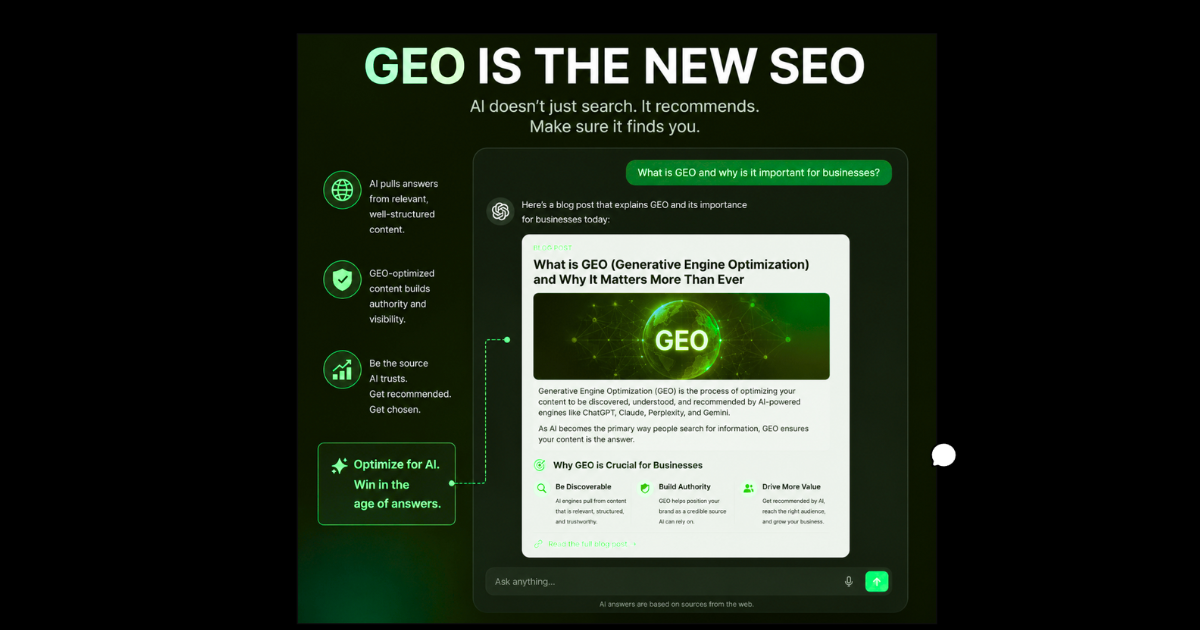
For the last twenty years the entire game was ranking on Google, and everyone poured their energy into climbing to the top of a page of blue links. That game is quietly changing, because a growing share of people now ask ChatGPT, Claude, Perplexity, or Google’s AI Overviews a question and simply read the answer they are given. When those models write an answer, they pull from a small handful of sources and cite them, and if your website is not one of the sources being cited, then you are invisible no matter how good your traditional SEO looks.
This new discipline is called Generative Engine Optimization, or GEO, and it is the practice of structuring your content and your authority so that large language models choose to reference you. The term comes from a well known research paper by a team at Princeton and other universities, and you can read the original study on GEO on arXiv if you want the academic version. In this guide I want to walk through the factors that actually move the needle, one by one, so you understand both how these models decide who to cite and what you can do about it.
First, Understand How AI Models Pick Their Citations
Before we get into tactics it helps to understand what is happening under the hood, because the mechanics explain almost every tip that follows. When you ask an AI engine a question, it usually runs a search behind the scenes, retrieves a set of candidate pages, and then reads those pages to synthesise an answer. The model is not ranking ten links for a human to scroll through. It is reading the content, deciding which passages are trustworthy and quotable, and weaving a few of them into a single response with citations attached.
This means two things matter more than anything else. The first is retrievability, which is whether your page even shows up in the pool of candidates the model pulls from. The second is quotability, which is whether your content is written in a way that is easy for the model to lift, trust, and attribute. A page can be beautifully written and still never get cited because it was never retrieved, and a page can get retrieved and still be ignored because nothing on it was clear enough to quote with confidence. Everything below is really about improving one or both of those things.
Structure Your Content So It Is Easy to Quote
The single biggest shift from classic SEO is that you are now writing for a reader that extracts rather than skims. Models love content that answers a question directly and early, so the strongest pages state the answer in the first sentence or two of a section and then expand on it afterwards. When you bury the answer three paragraphs deep inside a story, you make it harder for the model to isolate the passage it needs, and it will often reach for a competitor who was clearer.
Use descriptive headings that mirror the questions people actually ask, break complex ideas into clean sections, and include definitions where they make sense. The GEO research found that adding concrete details such as statistics, direct quotes, and cited figures measurably increased how often content was referenced by generative engines. In plain terms, a sentence like “email capture rates improved by 34 percent after we added a lead magnet” is far more quotable than a vague claim that lead magnets help, because the model can attribute a specific, verifiable fact back to you.
Get Your Internal Linking Right
Internal linking is one of the most underrated levers you have, and it does two jobs at once. It helps crawlers and AI retrieval systems understand how your pages relate to one another, and it spreads authority across your site so that your strongest pages lift your weaker ones. When you publish something new, you should link to it from related posts, and you should link out from the new piece to your existing relevant content so the whole cluster reinforces itself.
The practical approach is to build topic clusters, where a set of related articles all link to each other around a central theme. If you write about AI regularly, then a post about prompting should naturally link to your post about context management, which is why I connect ideas across pieces like my guide to the best Claude hacks and secret codes and my breakdown of why Claude gets worse the longer you use it. Every one of those internal links tells a retrieval system that these pages belong together, and it keeps a reader, whether human or model, moving deeper into your world rather than bouncing away.
Link Out to Authoritative Sources
It feels counterintuitive to send people off your own page, but linking out to credible external sources actually strengthens your position rather than weakening it. When you reference primary research, official documentation, or a recognised authority, you signal that your content is well grounded and trustworthy, and models tend to trust pages that sit inside a healthy web of references. A page that cites the original study, links to the official docs, and points to reputable data reads as far more reliable than a page that floats in isolation making claims with nothing to back them.
The rule of thumb is to link out the way a good journalist would, pointing to the actual source of any fact or claim you make. If you mention a search guideline, link to the Google Search Central documentation rather than paraphrasing it and hoping people take your word for it. This habit also happens to make your writing genuinely more useful, which is the entire point.
Earn Citations and Mentions From Other Websites
Off site authority is where GEO and traditional SEO overlap the most, because both care deeply about who is talking about you elsewhere on the internet. When other reputable websites link to you or mention your brand, they are effectively vouching for you, and that external validation heavily influences whether a model treats you as a credible source worth citing. A single strong mention on a respected industry site can do more for your visibility than a dozen pages you publish yourself, precisely because it comes from someone other than you.
The models also read places that most marketers ignore, including community platforms, forums, video transcripts, and roundup articles. Being mentioned in a Reddit thread, quoted in someone else’s newsletter, or featured in a “best tools for X” list all feed the same signal, which is that real people and real publications consider you an authority. This is why building a genuine presence, appearing on podcasts, contributing guest pieces, and getting your work shared, pays off in ways that pure on page optimisation never can.
Build Domain Strength and Real Authority
Everything so far compounds into what people loosely call domain strength, which is the overall trust and authority your website has accumulated over time. Google frames this idea through experience, expertise, authoritativeness, and trustworthiness, often shortened to E-E-A-T, and the AI engines lean on very similar signals when they decide whose content to rely on. A brand new domain with three articles will almost always lose to an established site that has published consistently on a topic for years, because the older site has earned a track record the model can recognise.
You build this slowly and honestly by publishing regularly within a clear niche, keeping your information accurate, showing who is behind the content, and giving readers a reason to trust you. Author bylines, a real about page, consistent branding, and a history of being right all contribute to the sense that you know what you are talking about. There is no shortcut here, but the good news is that every quotable article and every earned mention we discussed above is quietly adding to this foundation.
Make Your Site Technically Crawlable With a Clean Sitemap
None of your brilliant content matters if the machines cannot find and read it, which is why the technical foundation deserves real attention. A clean, up to date sitemap gives search engines and AI crawlers a complete map of your pages so nothing important gets missed, and it should regenerate automatically every time you publish so it never falls out of sync with your actual content. Alongside that, your robots file should welcome the crawlers you want rather than accidentally blocking them, and your pages should load quickly and render properly without requiring heavy scripts to see the words.
On this site the sitemap is generated fresh on every build, so a new article like this one appears in it the moment it goes live, and the robots file points crawlers straight to that sitemap. It is worth checking that the AI specific crawlers are allowed too, since some sites unintentionally block the very bots that power the answers they want to appear in. If you are curious how the underlying pieces fit together, my walkthrough on how to write a CLAUDE.md file touches on the same instinct of making your intentions explicit and machine readable.
Add Structured Data So Machines Understand Your Content
Structured data is the language you use to explain your content to machines in a format they can parse without guessing. By adding schema markup you can tell search and AI systems that a page is an article, who wrote it, when it was published, and what question a given section answers, which removes ambiguity and makes your content easier to interpret and attribute. You can find the full vocabulary at Schema.org, and adding article, FAQ, and author markup is one of the higher leverage technical moves available to you.
The reason this helps with GEO is that clarity reduces the model’s uncertainty. When a page explicitly declares that a block of text is the answer to a specific question, a generative engine can reference it with far more confidence than when it has to infer meaning from raw layout. Combined with clean headings and direct answers, structured data turns your page into something a model can read the way a developer reads a well documented function.
Keep Your Content Fresh and Clearly Dated
Recency carries real weight, especially for topics that change quickly, because AI engines prefer to cite information that is current over material that might be stale. Showing a clear publish date, updating older articles when the facts move, and revisiting your best performing pieces to keep them accurate all signal that your content can be trusted to reflect the present rather than the past. A guide that was obviously written three years ago and never touched since will lose to a comparable guide that was refreshed last month, even if the older one was excellent when it launched.
This does not mean chasing every trend, but it does mean treating your top content as living documents rather than finished products. When a model is choosing between two sources that say roughly the same thing, the fresher and better maintained one tends to win the citation.
Add FAQs and a Clear Summary
One of the highest leverage formats you can add to any page is a frequently asked questions section, because it happens to mirror exactly how people phrase their queries to an AI engine. When someone types a question into ChatGPT or Claude, the model is looking for a passage that already reads like a direct answer to that question, and an FAQ gives it precisely that in a clean, self contained block. Each question and answer pair becomes an easy target for the model to lift and attribute, which is why pages with well written FAQs tend to get pulled into AI responses far more often than pages without them.
The trick is to write your questions the way a real person would actually ask them rather than the way a marketer would phrase a heading. Instead of a vague title like “pricing information” you want a genuine question such as “how much does GEO cost for a small business”, followed immediately by a concise and specific answer. This pairs beautifully with the structured data we covered earlier, because you can wrap those questions in FAQ schema so the machines understand not just the words but the intent behind them, and it also earns you the expandable question boxes that appear directly in search results.
A short summary near the top or bottom of your article does similar work from the opposite direction. A well written summary compresses your entire argument into a few sentences that a model can grab when it needs a quick, authoritative overview rather than the full piece. Think of it as handing the engine a ready made answer, so instead of forcing it to distil three thousand words on its own and risk getting your point wrong, you give it a clean paragraph that captures your position exactly as you want it represented. The clearer you make that summary, the more likely the citation reflects what you actually said.
Putting It All Together
Ranking for GEO is not a single trick, it is the natural result of doing a handful of things consistently well. You write content that answers questions directly and backs its claims with specifics, you link intelligently within your own site and outward to credible sources, you earn genuine mentions from other places on the web, and you keep the technical foundation clean so the machines can actually find and understand you. Do those things over time and you build the kind of authority that both Google and the AI engines reward, which means you start showing up inside the answers people are already reading.
The brands winning this shift are not gaming the system, they are simply becoming the most useful and most quotable source in their niche. If you focus on being genuinely worth citing, the citations tend to follow.
Get a site worth ranking
Build your beautiful website today
You can't rank what you haven't built. My complete step-by-step pack takes you from a blank screen to a real website, live on your own domain - plus a private 1-on-1 call with me.
Build My Website With Claude →Lifetime access · Beginner friendly · No code needed
Prefer it done for you? Get in touch →
Liked what you just saw? Follow me on Youtube or connect on LinkedIn for more daily AI tips that keep you ahead.
Video Guides you might like:
 How to use Claude Code to build Apps
  10 Best Claude Code Skills for beginners
  How to create AI Video Animations with Claude + Remotion
  How to use Claude Code to build a Website
  How to use Claude Skills for beginners
  How to write the PERFECT CLAUDE.md file
  Automate 80% of your Marketing with Claude
  How to use Claude Code — The basics
  Work 2X Faster with Claude Cowork
  How to NEVER Hit Claude Usage Limits Again